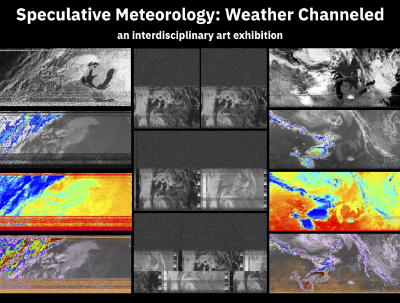
Speculative Meteorology: Weather Channeled
an interdisciplinary art exhibition
Special Projects Gallery at York University
February 3–7, 2025
Opening reception: February 5, 2025 from 5 - 7 PM
with work by artists and researchers:
Chris Beaulieu, Kwame Kyei-Boateng, Nava Waxman,
Mark-David Hosale, Hiro Kubayashi, Grace Grothaus,
Leo Liu, Winnie Luo, Aftab Mirzaei, and Colin Tucker.
Curated by Aftab Mirzaei
Environmental Monitoring for Art, a workshop
with Grace Grothaus
February 7, 2025 from 12 -3 PM
ACW 103, The Transmedia Lab at York University
Space is limited, sign-ups at: https://docs.google.com/forms/d/1xsziUcGj6pcLTR6yl0Sttjl7wvlvCSbbVKw1rFnt0Go/edit
In this three-hour workshop, we will fabricate sensors that can detect environmental data using some readily available materials and electronics.
We will fabricate sensors that can detect animal footsteps, record raindrops, or measure wind and then learn to read their values using Arduino. The data from these sensors can be used as input for actuators in physical computing projects, or they can be triggers for screen-based animation or music - the options are wide and varied.
Speculative Meteorology: Weather Channeled
The Speculative Meteorology:Weather Channeled exhibit has grown out of a series of experiments, provocations and field studies undertaken between 2023-2024 between members of the nd:studiolab. These inquiries encouraged participants to blend diverse epistemologies, including creative-aesthetic, cultural-interpretive, and utopian-speculative approaches. The goal was to create imaginative, multidimensional accounts of atmospheres and climates across temporal scales—past, present, and future.
The show is also guided by Donna Haraway’s notion of SF as a “mode of attention, a theory of history, and a practice of worlding”. In Haraway’s work, SF is not (just) Science Fiction but a practice of Speculative Fabulation, which calls on a broader range of imaginative and speculative practices that embrace the plurality of worlds that emerge from our speculative multisensorial knowledge. In the exploration of microclimates, atmospheres and ecosystems, SF may emerge as a Fictional Science and a rearrangement of knowledge-making practices.
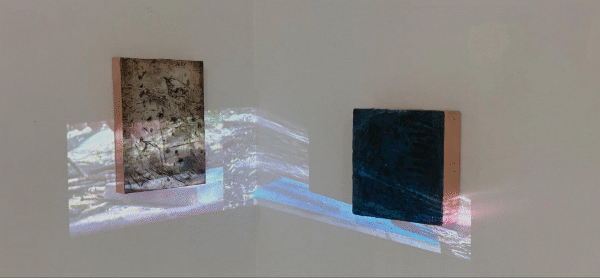
Across the exhibit, innovative approaches to speculative thinking are used to engage with the climate across different scales. In the collaborative pieces by Nava Waxman and Hiro Kubayashi, the atmosphere is the repository for the spiritual essence of Stong Pond and a hauntological nexus for the future and past that lingers tangibly in the present. Vibrations and narratives set in motion long ago can still be felt by, and indeed move the bodies of the artists as they render subtle ambient forces into physical and virtual surfaces.
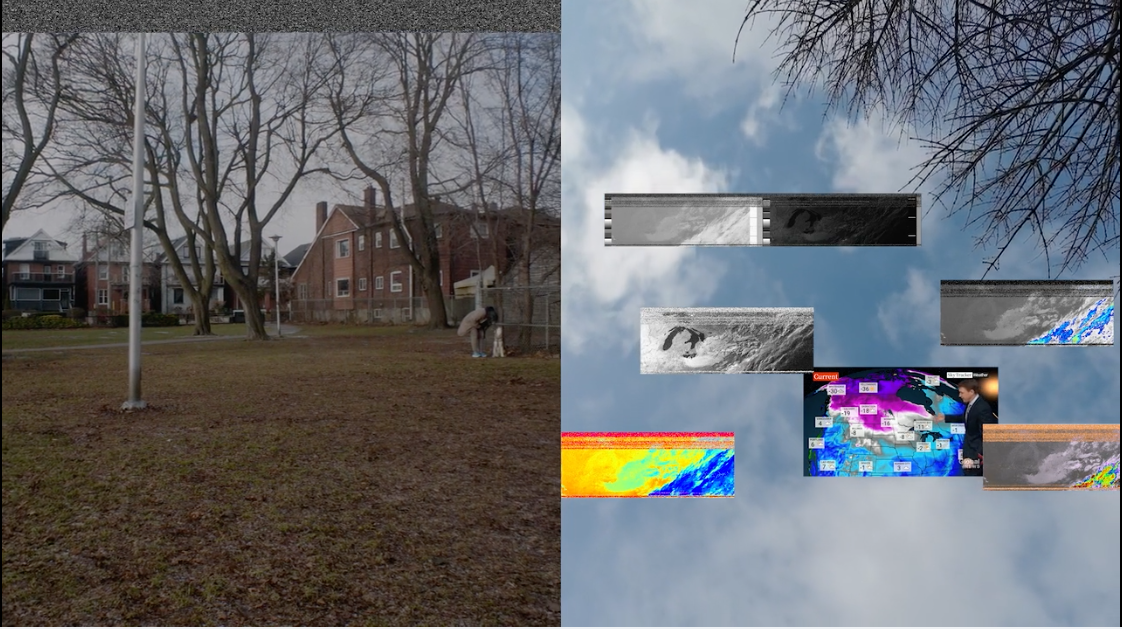
Signal and Image by Christopher Beaulieu and Aftab Mirzaei captures the extended moment when radio signals pull their bodies into direct conversation with NOAA weather satellites. The signal and noise connect us across different layers of the atmosphere, from the immediate critical zone to the planetary view from above. As satellite images render on the screen, we are made to question the weather as an entity already known and instead attune to it as perpetually in formation and unknown.
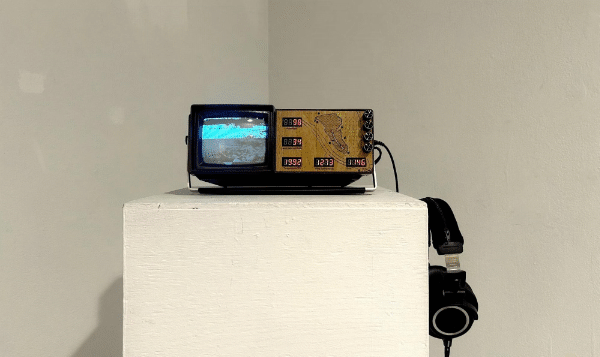
Similarly, Mark-David Hosale’s The Phenomoscope OS 624 bridges human experience and environmental observation, capturing synchronized data streams—physiological signals, weather, images, and sound. By exposing the instability of perception, the device becomes both an analytical tool and a reflection on the fleeting interplay of environment and affect as well as objective measurement and subjective memory.
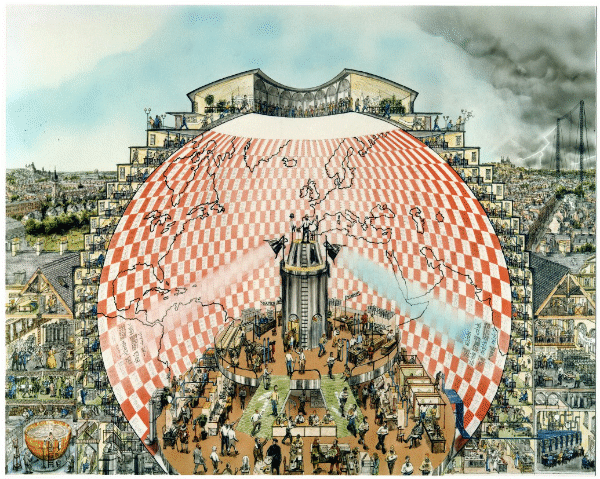
With a nod to forecasting’s fantastical roots in Richardson Fry’s Forecast Factory, Ambient Factory by Kwame Kyei-Boateng precipitates virtual clouds from the coalescence of particles rendered from environmental data collected on campus. In the VR environment, participants witness the process of cloud formation as an intimate and celestial event, offering a visceral connection to atmospheric phenomena
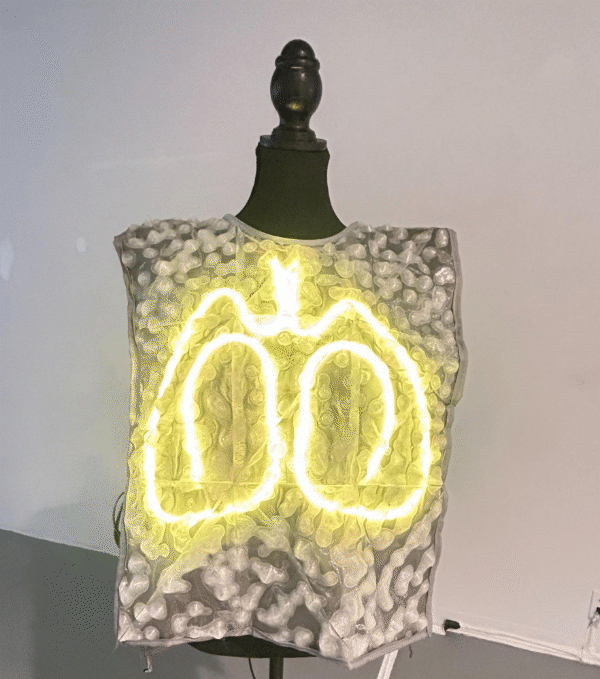
The theme of creaturing –transforming data into felt experience– also runs through Grace Grothaus’s AtmoSphere 01. The art object and wearable provides an infrastructure for the air to enter the realm of sensible through tangible and observable changes in the garment. Bodies, their polluted worlds and politics are foregrounded with an aesthetic strategy that ultimately is intended to bring about modes of political participation for empowered citizens.
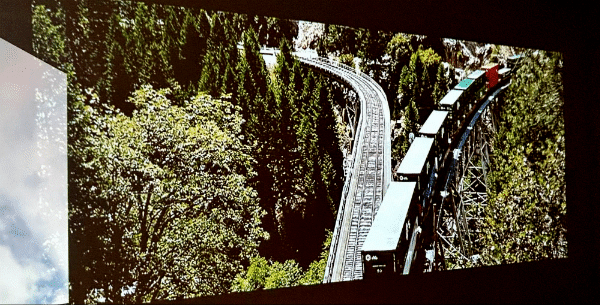
The video/sound installation In the Wake of the Santa Maria by Colin Tucker reveals the political potential of atmospheres by intertwining the mundane landscapes of global trade with the Global South's histories of climate and violence. This entanglement unfolds through sounds of Caribbean beaches sourced online. Rather than treating atmospherics as something to be fully understood or resolved, Tucker's work emphasizes the ineffable qualities of air and climate, highlighting their boundless and elusive nature.
Together, the pieces present a speculative toolbox of strategies to foreground relations and encounters across heterogeneous scales and re-entangle bodies in their technological, environmental, affective, and more-than-human relations. This has required the artists to take up the notion of atmosphere not only in its material and meteorological form but also as a medium for knowledge-making and practice and a metaphor for broader social, cultural, and political currents.
- Aftab Mirzaei, February 2025
1. Haraway, Donna J. Staying with the Trouble Making Kin in the Chthulucene. Durham and London: Duke University Press, 2016, 105.
2. Latour, Bruno, and Peter Weibel. Critical Zones. The Science and Politics of Landing on Earth. MIT Press, 2020.
Phenomoscope OS 624 
Mark-David Hosale, 2025
The Phenomoscope OS 624 is a workbench-based instrument designed for the simultaneous recording and playback of multi-dimensional data streams. Its core functionality revolves around the integration of physiological signal monitoring, image capture, audio recording, atmospheric and weather analysis using precise time synchronization. By processing and correlating these diverse inputs, the device facilitates an analysis of the interplay between environmental factors and human affective states.
Central to the Phenomoscope OS 624’s operation is its ability to bridge objective measurements and subjective experiences. However, this dual focus contains an inherent paradox: much like the uncertainty principle, simultaneous comprehension of both the objective and subjective domains is mutually exclusive. The captured data provides invaluable insights, yet the representation of memories is inherently distorted, with recollections often fragmented and imprecise during playback.
To overcome this inequity the Phenomoscope OS 624 is built around a modular interface, featuring an array of dials that enable the operator to finely tune signal pathways. Each control governs specific aspects of the data streams, allowing for meticulous adjustment to achieve an oscillatory coherence—a state where signals align optimally for accurate correlation. This coherence is vital but transient, as the signal stability is inherently prone to drift, requiring continuous monitoring and recalibration by the operator.
The device architecture incorporates:
Signal Capture Module: Handles the input of physiological data, video, and audio, synchronizing them with weather and timestamp data.
Signal Processing Unit: Employs high-fidelity circuitry for real-time tuning and filtering.
Signal Playback Module: Converts stored data into accessible formats, albeit with inherent inaccuracies reflective of the complementarity of the objective and subjective domains.
The Phenomoscope OS 624’s sensitivity to environmental and operator conditions reflect its design philosophy—to explore the ephemeral nature of perception and memory. This makes it not only a powerful analytical tool but also a study in the challenges of interfacing objective reality with human subjectivity.
Operators are advised to familiarize themselves with the calibration procedures outlined in the manual to achieve optimal performance and maintain signal integrity during extended use.

in the wake of the santa maria
Video/Sound Installation
Colin Tucker, 2021-2023
in the wake of the santa maria is a work that positions perpetrators of global warming within long histories of imperialism, through audio interventions in proximity to carbon-producing infrastructure. The audio consists of re-edited audio footage of ocean waves from a “relaxing Caribbean beach” video, alluding to the literal and historical wakes of ships engaged in conquest (the title refers to the santa maria ship taken by Christopher Columbus). The footage also references particular historical wakes of conquest, specifically global warming-caused rising sea levels and colonial figurations of empty(-ied) islands.
The present piece approaches atmosphere as object of analysis, and as method, in ways that contest modernist Western binaries such as art/science, global/local, and metropole/colony. The piece offers speculative mappings of 1) how global warming weaponizes the earth’s atmosphere and 2) how this weaponization participates in the production of, to paraphrase Frantz Fanon, an atmosphere of imperial violence. Through an open-ended, situated, score-based approach, the piece is able to engage with almost any Global North carbon-emission-producing infrastructure within its decolonial framework. In these ways, the piece ruptures the banality of the Global North Everyday atmospheres, through attention to this atmosphere's continuities and entanglements with Global South atmospheres of climate chaos/violence.

AtmoSpheres 01
Wearable: Custom electronics and 3D-printed fabric
Grace Grothaus, 2024
AtmoSpheres 01 is the first of a series of wearable art objects that envelop the wearer in vibrant, multi-textured assemblages, dynamically reacting to the environment. Using fluid transformations of LED light, these pieces immediately respond to air pollution. For example, when toxic levels of fine carbon particulate (PM2.5) are detected—such as when cars pass by—the wearables light up in the yellow, orange, and red hues of the Air Quality Index, symbolizing the impact on lungs and cardiovascular systems.
This visual representation makes PM2.5 visible, translating abstract data into tangible, compelling narratives that foster understanding and drive public engagement. These wearables aim to empower citizens to ‘see’ their air quality firsthand and raise questions about how citizen science can play a role in reducing toxic exposures.

The Ambient Factory
Kwame Kyei-Boateng
3D Visualization, 2024
The Ambient Factory, is inspired by Stephen Conlin's Weather Forecasting Factory,which is itself a depiction of Lewis Fry Richardson's Forecast Factory, a fantasized method of weather prediction involving a large, spherical building filled with tens of thousands of human computers busily forecasting the weather.
The Ambient Factory involves the collection of ambient light values around York University using the Arduino Science Journal app, which are saved in a CSV file that feeds into Unreal Engine’s Niagara FX System, creating a particle system of clouds. The visualization begins as a subdued black-and-white low poly depiction of York University encased in a dome-like structure. As the CSV data is cycled through, the ambient light values are used to affect both the emissive level of the cloud particles and the saturation level of the entire visualization, revealing a more colourful and vibrant world and highlighting a stylized, painterly environment.
Signal and Image
Video Installation
Christopher Beaulieu, Aftab Mirzaei,2025
Signal and Image traces the DIY process of satellite imaging, capturing real-time NOAA weather data while exploring the entanglement of signals, atmospheres, and speculative futures. The installation presents two synchronized visual streams: one documenting the context where the live transmissions are received and the other revealing the weather imagery as it materializes line by line.
The split-screen composition weaves together skyward views of where satellites pass, grounded perspectives, and archival weather broadcasts—remnants of past meteorological imaginaries. Images are layered with the raw sounds of satellite signals, the noise of transmission, and fragmented voiceover reading an AI-generated weather forecast from the future. These elements merge to tell a trans-scalar story of satellites, radio waves, and atmospheric mediations, both lived and imagined.

Inscription of Tomorrow
Transmedia Installation: Video, AR Environment, Encaustic Works
Nava Waxman and Hiromune Kubayashi, 2024
How can artistic research engage with the performative act of mediation? This work explores hauntology as a method for representing environmental phenomena, drawing from Avery Gordon’s notion of haunting—where the past insistently lingers in the present. As part of a collaborative weather and climate field guide at nd::StudioLab, we investigate Stong Pond’s uncanny presence through repeated visits, embodied listening, and site-specific interventions.
Using experimental audio-visual recordings, performance actions, and augmented reality soundscapes, this transmedia installation reinterprets environmental data beyond traditional scientific methods. By embracing speculative and poetic mediation, we generate aesthetic forms that reveal the unseen spectres of ecological crises.

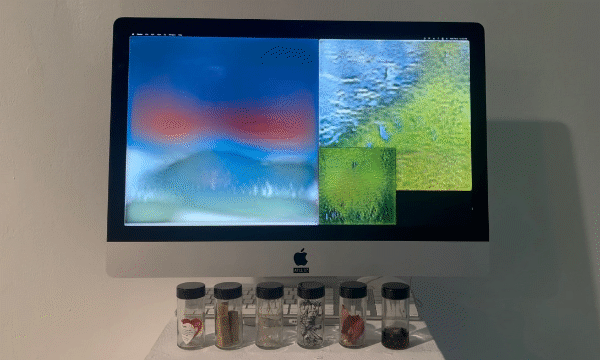
Mood Diary
Leo Liu& Winnie Luo, 2025
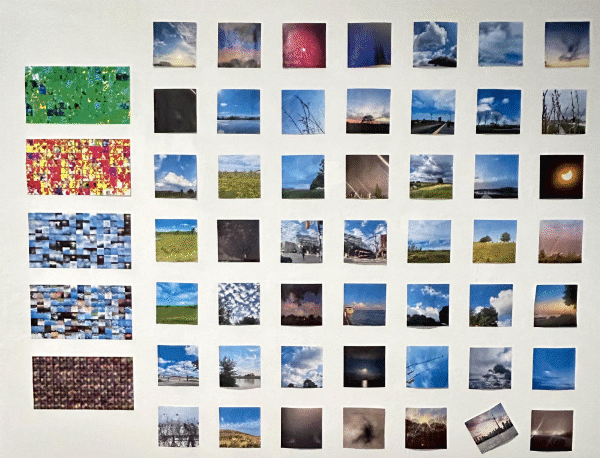
Mood Diary is a visual record of emotions based on 100 photographs of the Toronto sky taken at different times throughout the year. Arranged in a 7×8 grid on the wall, these images are accompanied by a monitor displaying fluid visuals that shift between abstraction and representation. Using light, colour, texture, and text, the piece evokes sensory perception and emotional resonance. Mood Diary explores the subtle connections between weather, environment, and mood, inviting viewers to intuitively engage with the shifting atmospheres and evolving states of mind over time.
n-D::StudioLab
York University • School of the Arts, Media, Performance, and Design • Toronto, Canada
this site and its contents © 2026 Mark-David Hosale